Gdańsk & Sopot Guide: Best Time to Visit, Attractions & Tips
A photographer's guide to Gdańsk and Sopot — the best time to visit, the Motława riverfront and Sopot pier, the SKM train between them, a 3-day plan, and local tips.
Gdańsk and Sopot are twenty minutes apart on a commuter train, and treating them as one trip is the single best decision you can make on Poland's Baltic coast. Gdańsk gives you a reconstructed Hanseatic old town, a river lined with brick warehouses, and some of the heaviest 20th-century history in Europe. Sopot, one stop north, gives you a spa town, a pine-backed beach, and the longest wooden pier in Europe. Together they're a comfortable three days — four if you want a slow one.
This is a working photographer's guide: when the light and the crowds are right, what's actually worth your time, how to move between the two cities, and the practical stuff nobody tells you until you're standing there.
Where Gdańsk and Sopot are
Both sit on the Bay of Gdańsk in northern Poland, part of a conurbation Poles call the Tricity (Trójmiasto): Gdańsk, Sopot and Gdynia, strung along about 30 km of coast. Gdańsk is the historic and cultural anchor in the south, Gdynia the modern port in the north, and Sopot the resort town wedged between them.
Gdańsk Lech Wałęsa Airport (GDN) is 12 km west of the old town, with direct flights from most of Western and Central Europe. From the airport, the PKM/SKM train or a taxi gets you into the centre in around 30 minutes. Coming overland, Gdańsk is about 4.5 hours from Warsaw by fast train, 5–6 hours by car from Berlin, and roughly 6 hours from Kraków.
When is the best time to visit Gdańsk and Sopot?
The Baltic coast has a short, bright summer and a long, moody shoulder season. Here's how the year actually feels on the ground.
June to August — warmest, busiest
Long days (sunset near 21:30 in late June), water warm enough to swim in by late July, and every terrace on Monte Cassino full. This is also when St. Dominic's Fair (Jarmark św. Dominika) takes over central Gdańsk for three weeks from late July into mid-August — hundreds of stalls, concerts, and a genuinely festive old town. Great atmosphere, terrible if you wanted clean architectural photos: expect tents in front of everything and accommodation prices at their peak.
May and September — my pick
Mid-May to mid-June and the first three weeks of September are the sweet spot. Daytime temperatures sit comfortably in the high teens to low twenties, the old town is walkable rather than shuffling, hotel rates drop noticeably, and the light is softer with more interesting cloud. September still has warm-ish sea water (the Baltic lags the air by weeks) and empty beaches on weekdays.
October to April — moody and cheap
Short days, wind off the bay, and frequent grey — but this is when the riverfront looks most like the Hanseatic port it was, and the museums are the point anyway. December brings a well-run Christmas market on Targ Węglowy. January and February are genuinely cold and windy on the pier; bring a proper shell.
One planning note that applies year-round: this is a northern coast, and weather changes fast. Build a museum or two into your itinerary as rain insurance rather than assuming you'll be outside all day.
Getting between Gdańsk and Sopot
You do not need a car. The SKM commuter train runs along the coast between Gdańsk Główny, Gdańsk Oliwa, Sopot and Gdynia Główna every 10–15 minutes for most of the day. Gdańsk Główny to Sopot takes about 20 minutes and costs a few złoty.
- Buy tickets from the machines on the platform (card accepted) or in the SKM/Jakdojade app, and validate paper tickets in the yellow validator before boarding — inspectors do check.
- Gdańsk itself has trams and buses; the old town is small enough that you'll walk almost everywhere within it.
- Driving into central Gdańsk is more hassle than it's worth — narrow streets, paid zones, and limited parking. If you arrive by car, park at your hotel or a park-and-ride and use the train.
Top attractions in Gdańsk
Długi Targ and the Neptune Fountain
The Long Market is the spine of the old town: wide, theatrical, lined with reconstructed merchant façades and bookended by the Golden Gate and the Green Gate. The 17th-century Neptune Fountain sits in front of Artus Court. Shoot it early — by 10:00 in summer it's wall-to-wall people.
The Motława riverfront and the Gdańsk Crane
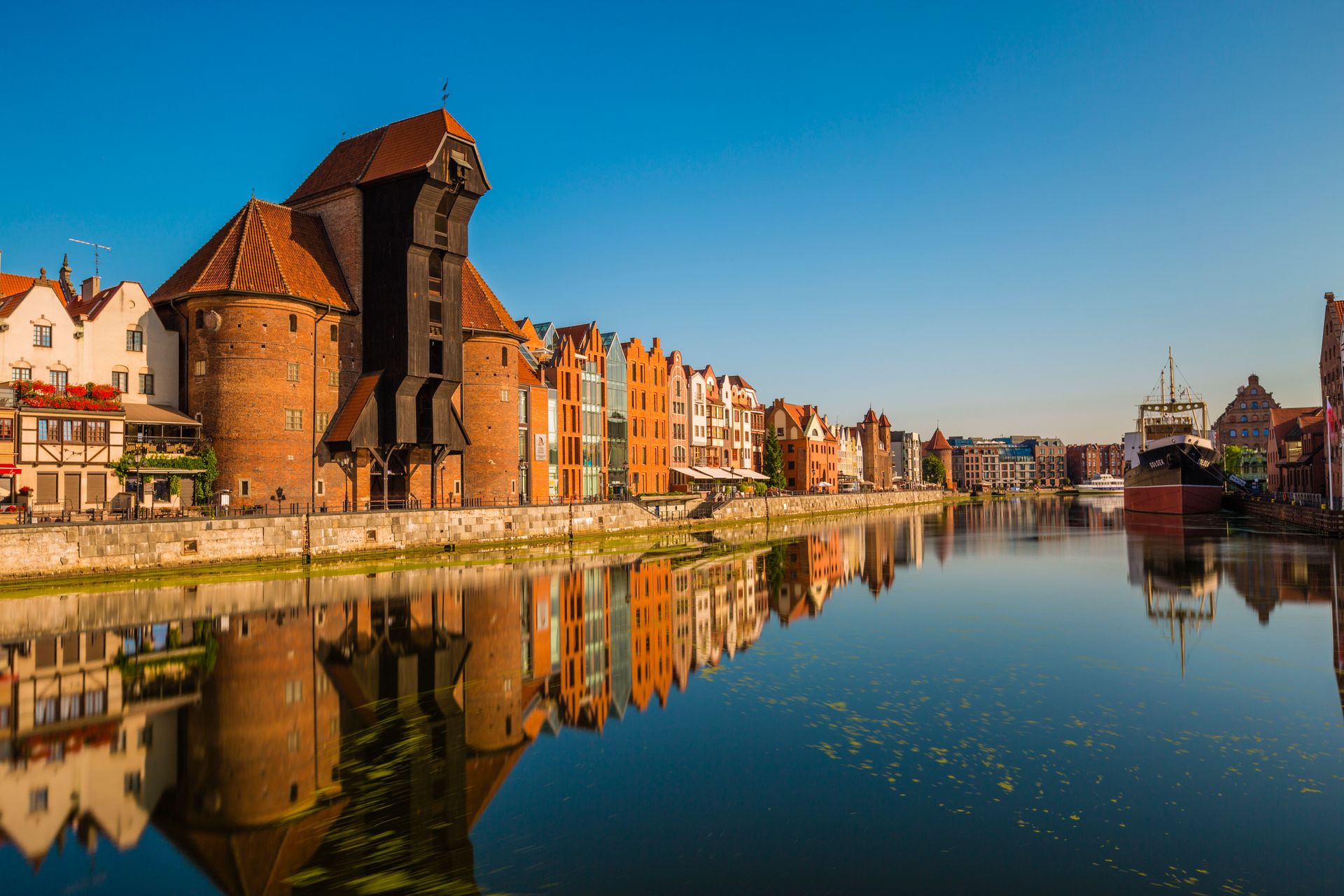
Walk out through the Green Gate and turn left along Długie Pobrzeże. The Crane (Żuraw) — a huge medieval timber port crane built into the brick gate — is the city's signature building. Cross to Ołowianka island or stand on the Mariacka footbridge for the full reflection line-up of gabled houses. This is the frame in the photo above.
St. Mary's Church tower
One of the largest brick churches in the world. The climb is around 400 steps of narrow stairs, and the reward is the only high vantage point over the old town's red roofs and the bay behind. Go on a clear afternoon.
Mariacka Street and amber
The prettiest street in the city: stone terraces, gargoyle downspouts, and amber workshops in every basement. Gdańsk is the historic centre of the Baltic amber trade, and Mariacka is where to buy — from a shop with a certificate, not a stall.
Museum of the Second World War
A major, genuinely affecting museum in a striking tilted tower. The main exhibition is largely underground and takes 2.5–3 hours to do properly. Book online in high season.
European Solidarity Centre
Built at the gates of the former Lenin Shipyard, where the Solidarność strikes began in 1980. If you want to understand why Gdańsk matters beyond its skyline, this is the stop. Allow two hours.
Westerplatte and Oliwa
A pleasant way to spend a half day: take the water tram or a tourist boat down the Martwa Wisła to Westerplatte, where the first shots of the Second World War were fired. On the other side of the city, Oliwa Cathedral has a famous baroque organ with short daily recitals, and the adjacent park is a quiet break from the centre.
Top attractions in Sopot
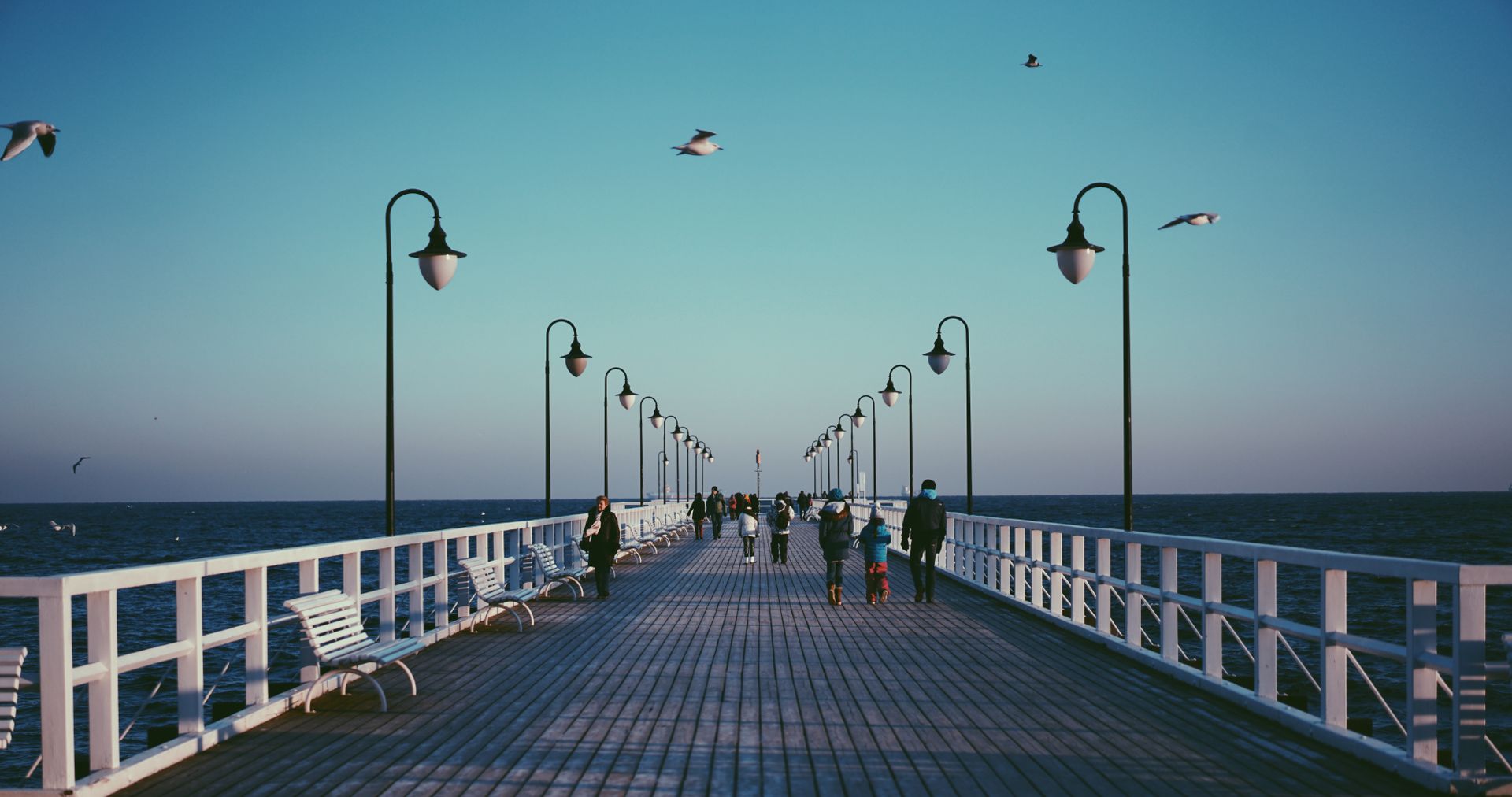
The Molo (Sopot Pier)
At 511 metres, the longest wooden pier in Europe. There's a small entry fee in the summer season and it's free out of season. Walk to the end for the view back at the shoreline and the Grand Hotel. Photographically it's a gift: converging railings, evenly spaced lamps, and gulls that will pose for you if you're patient. Sunrise faces the water; sunset lights the town behind you.
Monte Cassino Street
"Monciak" is the pedestrian artery running from the train station down to the pier — cafés, ice cream, buskers, and the whole town funnelling toward the sea. Loud in July, charming in May.
The Crooked House (Krzywy Domek)
A warped, fairy-tale commercial building halfway down Monciak. It's an oddity rather than an attraction, but it photographs well with a wide lens from across the street.
The beach and the spa town
Sopot's beach is wide, sandy and backed by pines, running for kilometres in both direction. Walk north toward Gdynia or south toward Gdańsk Brzeźno and you'll lose the crowds within fifteen minutes. Sopot has been a saltwater spa since the 19th century; the wooden bathhouse architecture and the lighthouse at the Grand Hotel end are worth the detour.
Photography notes
- Motława reflections: the water is calmest in the first hour after sunrise. Stand on the Ołowianka side for the classic Crane line, or on the footbridge at Mariacka for tighter gables. 24–35 mm covers most of it.
- Blue hour on the riverfront: about 20–30 minutes after sunset, when the warm façade lighting balances the sky. Bring something to brace the camera on — the quay walls work fine.
- Sopot pier: shoot centred and low for the strongest symmetry, and go before 08:00 if you want the boardwalk empty. Overcast days flatten the sea into a clean grey band, which suits the white railings.
- Drones: central Gdańsk sits inside controlled airspace near the airport, and much of the coast has restrictions. Check the zones in the national app before you unpack anything — I've written up how the EU rules work in the EASA Open Category guide.
What to eat
- Pierogi — the default, and worth having at least twice: ruskie (potato and curd cheese) and a meat version.
- Baltic fish — fried cod, herring in oil, and smoked fish from the stalls near the harbours. Sopot and Gdynia do this better than the Gdańsk tourist strip.
- Żurek — sour rye soup, ideal on a grey day.
- Goldwasser — a Gdańsk herbal liqueur with flakes of gold leaf, produced here since the 16th century. One glass is a nice piece of local history.
- Milk bars (bar mleczny) — canteen-style, very cheap, very Polish. Worth one lunch.
A 3-day Gdańsk and Sopot itinerary
Day 1 — Gdańsk old town
Sunrise on the Motława, breakfast near Mariacka, then Długi Targ, St. Mary's tower climb, and the amber shops. Afternoon in the Museum of the Second World War. Dinner on the riverfront and blue hour from the footbridge.
Day 2 — Sopot
SKM north after breakfast. Pier first while it's quiet, then coffee on Monciak, then a long beach walk toward Gdynia. Swim if it's July or August. Late afternoon light on the town side of the pier, dinner in Sopot, train back.
Day 3 — history or the coast
Either the European Solidarity Centre plus the shipyard district, or the boat down to Westerplatte and Oliwa Cathedral in the afternoon. With an extra day, add Gdynia's waterfront or the long sand spit at Hel.
Local tips
- Currency: Poland uses the złoty (PLN), not the euro. Cards and contactless work almost everywhere; carry a little cash for small stalls.
- The Baltic is cold. Sea temperatures peak around 18–20°C in August. It's swimmable, briefly, and glorious.
- Wind, not temperature, decides your comfort. Bring a windproof layer in any season — the pier and the beach are always breezier than the forecast suggests.
- Buying amber: real amber is warm to the touch, light, and shouldn't be suspiciously cheap. Buy from a certified shop on or around Mariacka.
- Avoid or embrace the Fair. If you're coming for photography, skip late July to mid-August in central Gdańsk. If you're coming for atmosphere, aim straight at it.
- Tipping: around 10% in restaurants if service isn't included. Say the total you want to pay before handing over your card.
- Sundays: most large shops are closed under Polish trading law; restaurants, cafés and museums are open as normal.
FAQ
Is Gdańsk worth visiting?
Yes — and more than most people expect. It combines a genuinely beautiful reconstructed old town with two world-class modern museums and immediate access to a beach resort. It's also still noticeably cheaper than comparable Western European city breaks.
How many days do you need for Gdańsk and Sopot?
Three full days covers both comfortably: two in Gdańsk, one in Sopot. Four lets you add Westerplatte, Gdynia or the Hel peninsula without rushing.
Should I stay in Gdańsk or Sopot?
Stay in Gdańsk if you care about the old town, museums and evening atmosphere — which is most visitors. Stay in Sopot if you're travelling in summer and want the beach on your doorstep. Either way, the SKM makes the other city a 20-minute hop.
Can you swim in the sea at Sopot?
Yes, mainly in July and August, when water temperatures reach the high teens. The beach is sandy with a gentle shelf and lifeguarded sections in season. Outside summer it's a walking beach, not a swimming one.
Are Gdańsk and Sopot walkable?
Very. Gdańsk's old town is compact and flat, and Sopot's whole centre is one pedestrian street between the station and the pier. You'll only need transport for the airport, the shipyard district and travelling between cities.
Is English widely spoken?
In hotels, restaurants and museums, yes — especially among younger staff. A couple of Polish words (dziękuję, proszę) go a long way anyway.
Bottom line
Come in May or September, base yourself in Gdańsk, and give Sopot a full day rather than a hurried afternoon. Shoot the Motława at first light and the pier before breakfast, and you'll leave with the two frames this coast is known for. If you're looking for another side of Poland, my guide to an off-grid cottage in the Sudetes covers the mountains at the opposite end of the country.
Planning a campaign, hotel shoot or destination feature on the Polish coast? Get in touch — I work on commission across Europe.