Bratislava Travel Guide: History, Sights & 2-Day Plan
Bratislava travel guide — explore the castle, Old Town and Devín, understand the city's history, and follow a practical one or two-day itinerary.
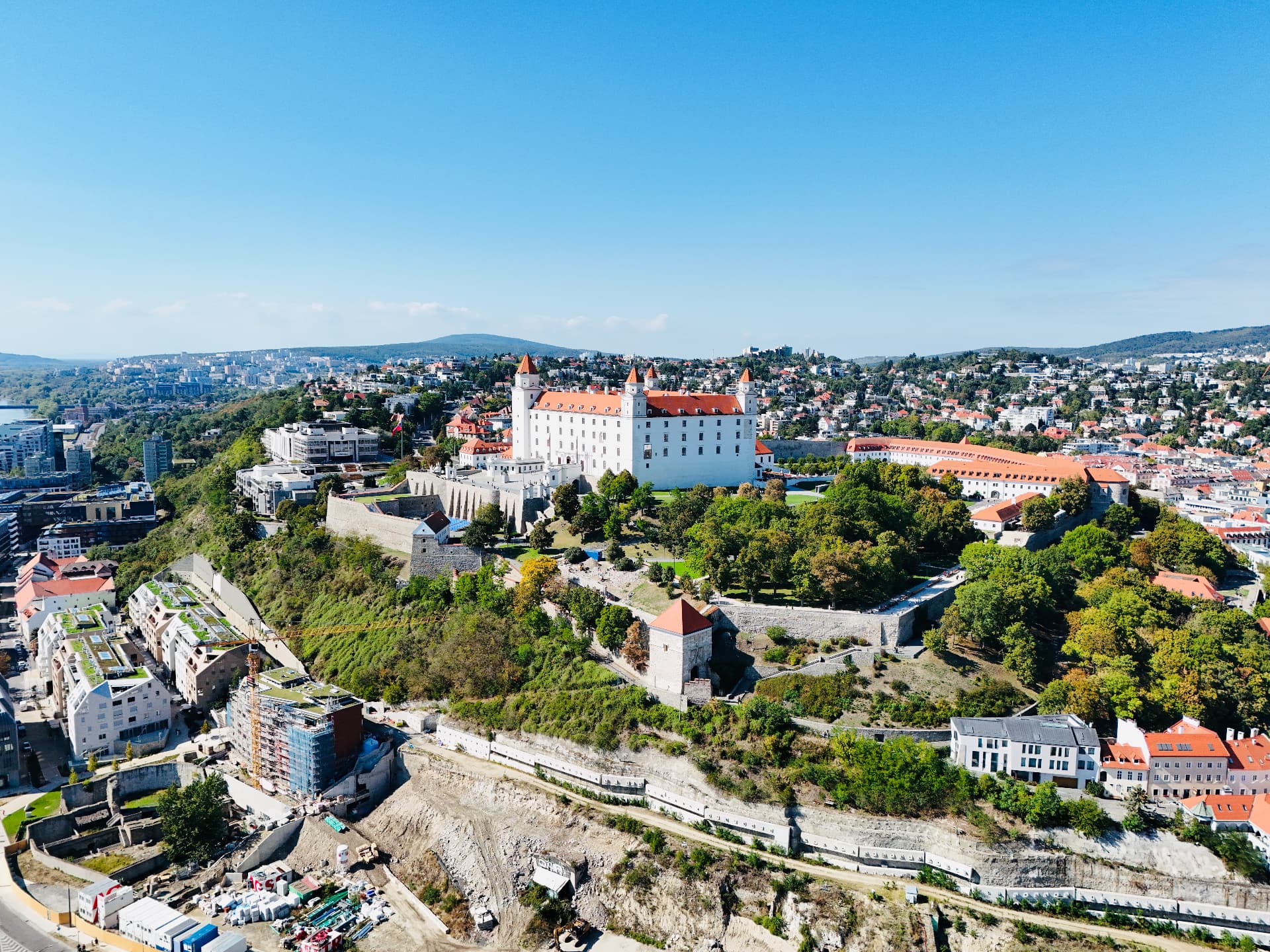
Bratislava is one of Europe's most underestimated capitals. It sits where the Danube passes the last slopes of the Carpathians, within sight of Austria and only about an hour from Vienna. A hilltop castle watches over a compact medieval centre; below it, trams, cafés and the unmistakable UFO tower show that this is a living capital rather than a preserved old town.
Its scale is the advantage. You can walk from a Hungarian coronation cathedral to a socialist-era bridge in minutes, spend the afternoon at the ruins of Devín Castle, and still be back beside the Danube for sunset. This guide explains why Bratislava matters, what deserves your time, how to arrive, and how to organise one or two days without turning the visit into a race.
A short history of Bratislava
People have controlled this bend of the Danube for more than two thousand years. Celts established a fortified settlement and minted coins here before the Romans secured the river as the northern frontier of their empire. The Roman military camp at Gerulata, now in the Bratislava district of Rusovce, formed part of the Danube Limes. The location explains the city's lasting importance: this was a crossing point between western, central and south-eastern Europe.
The medieval city developed below the castle and became known by several names — Pressburg in German, Pozsony in Hungarian and Prešporok in Slovak. After Ottoman forces captured Buda in 1541, Pressburg became the capital and coronation city of the Kingdom of Hungary. Between 1563 and 1830, eleven Hungarian kings and eight queens were crowned in St Martin's Cathedral. Brass crowns set into today's pavements trace parts of that ceremonial route through the Old Town.
Under Maria Theresa in the eighteenth century, the castle and city reached a period of courtly importance. Bratislava later became part of Czechoslovakia in 1918. The twentieth century brought wartime persecution, Communist rule, the construction of vast Petržalka housing estates and the SNP Bridge, and the peaceful Velvet Revolution of 1989. When Czechoslovakia separated in the Velvet Divorce, Bratislava became the capital of independent Slovakia on 1 January 1993.
Why Bratislava is important — and worth visiting
- A coronation capital. For nearly three centuries, it occupied a central place in the Kingdom of Hungary and the Habsburg world.
- A border city. Bratislava is the only national capital bordering two other countries: Austria and Hungary.
- The Danube corridor. The river connected Roman frontiers, medieval trade and today's Vienna–Bratislava–Budapest route.
- Visible layers. Gothic lanes, baroque palaces, socialist engineering and new waterfront districts sit within one walk.
- Manageable scale. It offers a real capital-city story without the distances or crowds of Vienna and Prague.
What to visit in Bratislava
Bratislava Castle
The rectangular white castle with four corner towers is the city's defining image. Its hill held Celtic and Slavic fortifications before becoming a royal castle. Fire left the complex in ruins in 1811, and the present appearance comes largely from twentieth-century reconstruction. Walk up through the lanes behind St Martin's Cathedral, explore the courtyards and baroque garden, then circle the terraces for views of the Danube, Petržalka and the Austrian wind farms. The grounds and viewpoints are the main experience; allow extra time if you visit the museum inside.
Old Town, Main Square and Michael's Gate
Bratislava's Old Town is small enough to wander without a route. Start at Hlavné námestie, the Main Square, framed by pastel façades, the Roland Fountain and the Old Town Hall. Its museum and tower give a useful introduction to the city. Continue through courtyards to Michael's Gate, the only surviving medieval city gate. The upper balcony is one of the best close views over the tiled roofs.
The much-photographed bronze figures — Čumil peering from a manhole and Schöne Náci tipping his hat — are modern, but they capture the playful public life of the centre. Look beyond them into the passages connecting Ventúrska, Panská and Michalská streets.
St Martin's Cathedral and the coronation route
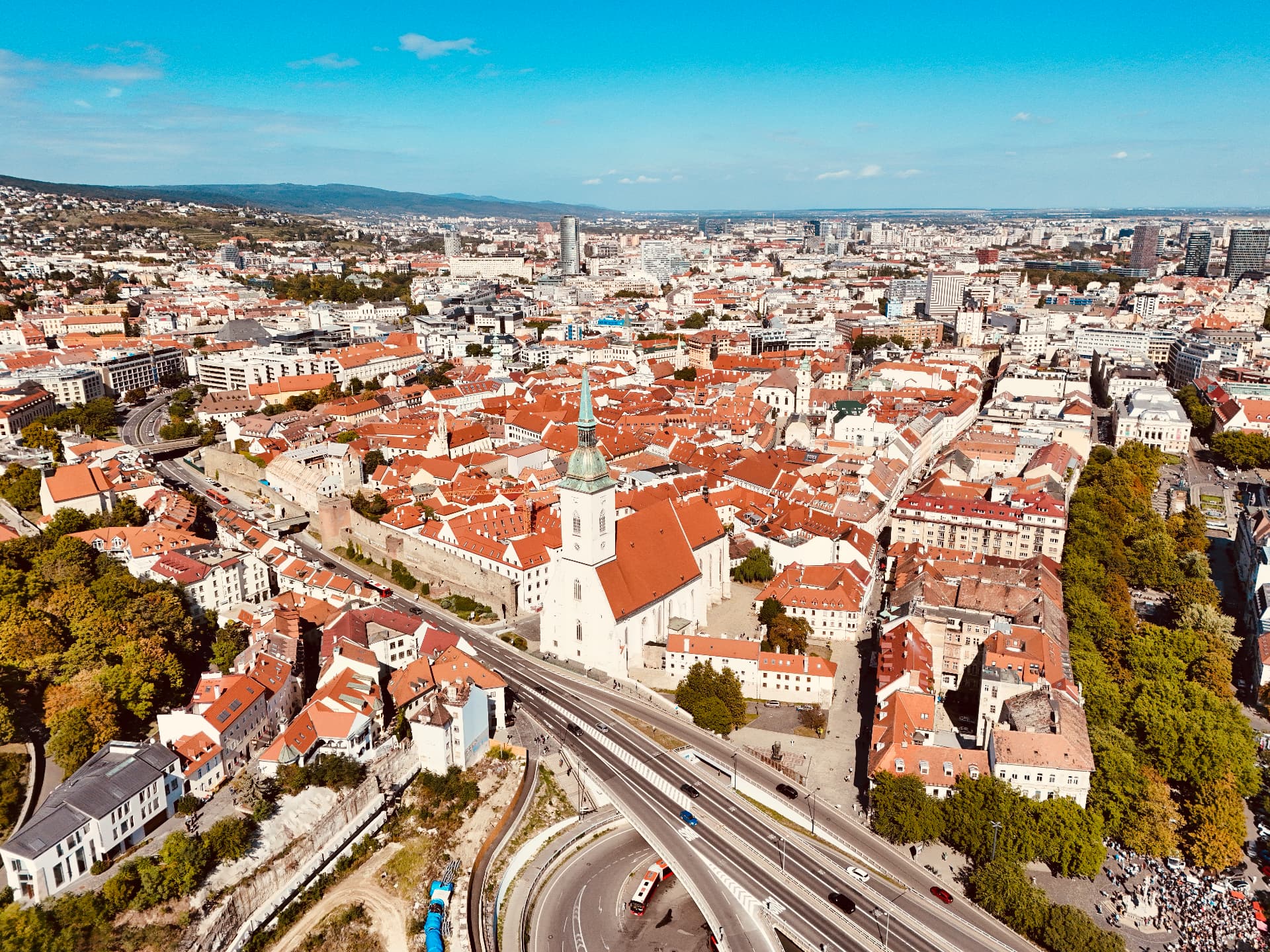
St Martin's is the essential historical building. The Gothic cathedral stands below the castle beside the former city walls, with a gilded replica of the Hungarian crown on its tower. Its importance is greater than its restrained interior suggests: this was the coronation church while the city served as Hungary's capital. Follow the crown markers from here toward the Old Town to turn that history into a walk.
Palaces, churches and the waterfront
- Primate's Palace. A pale neoclassical palace where the Peace of Pressburg was signed in 1805; see the Hall of Mirrors and rare English tapestries.
- The Blue Church. St Elizabeth's Church is an Art Nouveau confection of blue plaster, mosaics and glazed roof tiles, about a 15-minute walk from the square.
- Grassalkovich Palace. Slovakia's presidential palace, fronted by a public garden and a formal changing of the guard.
- Slovak National Theatre. The historic opera house closes the elegant Hviezdoslav Square; the newer theatre stands in the Eurovea waterfront district.
- Danube promenade. Walk from the Old Town past river cafés and Eurovea, or west beneath the castle for the best views of the SNP Bridge.
UFO Observation Deck and Slavín
The SNP Bridge, completed in 1972, is controversial: construction destroyed much of the old Jewish quarter, including its synagogue. Its flying-saucer restaurant and observation deck nevertheless offer the widest city view. Go near sunset, when the castle is lit across the river. Slavín, on the hills north of the centre, is a monumental cemetery for Soviet soldiers killed in the 1945 liberation of Bratislava. The site is solemn, quiet and another excellent viewpoint.
Devín Castle: the essential half-day trip
Devín stands where the Morava meets the Danube, directly on the Austrian border. Romans watched the frontier here; later rulers built a fortress controlling river trade. Napoleon's army destroyed much of it in 1809, leaving dramatic ruins above the confluence. Take a public bus from the city, allow two to three hours, and check opening times because the upper site can close in poor weather or winter. In warm months, a boat from central Bratislava turns the outing into a river journey.
Best time to visit
May, June, September and early October are best: mild weather, terrace season and comfortable walking. Late September adds colour around the castle. July and August are hot and busier with day-trippers, though riverside evenings are excellent. December brings Christmas markets to the Main Square; atmospheric, but daylight is short. January and February are quiet and inexpensive, with cold wind off the Danube. Two full days are ideal in any season.
A practical Bratislava travel plan
Day 1 — castle, coronation city and the Danube
- 08:30: walk to Bratislava Castle before tour groups arrive; circle the terraces and gardens.
- 10:30: descend to St Martin's Cathedral and follow the coronation markers into the Old Town.
- 12:00: lunch near Panská or Ventúrska, away from the most obvious square-side terraces.
- 13:30: Main Square, Old Town Hall, Primate's Palace and Michael's Gate.
- 16:00: walk to the Blue Church, then continue to the Eurovea waterfront.
- Sunset: cross the SNP Bridge for the UFO deck, or stay on the north bank and photograph the bridge and castle together.
Day 2 — Devín, Slavín and neighbourhood time
- Morning: bus or seasonal boat to Devín Castle; walk the ruins and river-confluence viewpoints.
- Early afternoon: return for lunch, then visit the city museum or Slovak National Gallery.
- Late afternoon: take a bus or walk uphill to Slavín for the memorial and panorama.
- Evening: dinner around Námestie SNP or the Old Market Hall area, followed by a final walk through the illuminated Old Town.
One day from Vienna
Arrive before 09:00. Go directly to the castle, descend through St Martin's Cathedral, then spend midday in the Old Town. Visit the Blue Church after lunch and finish on the Danube or UFO deck before an evening train or bus. Do not add Devín to a one-day trip unless you are willing to skip museums and the slower café side of the city.
Getting there and around
- From Vienna: frequent trains link Vienna Hauptbahnhof and Bratislava in about an hour. Buses also serve the centre, and seasonal boats use the Danube.
- From Vienna Airport: direct buses usually take around 45–60 minutes, making it a useful gateway even if you never enter Vienna.
- From Budapest: direct trains take roughly 2.5 hours; coaches can be competitive.
- From Prague: direct trains take around four hours. From Brno, allow about 1.5 hours.
- From Poland: direct or connecting rail and coach services run from Kraków, Katowice and Wrocław; compare timings because routes change seasonally.
- By air: Bratislava Airport handles mostly European low-cost routes. Public buses connect it with the main station and centre.
- In town: the historic centre is best on foot. Trams, trolleybuses and buses cover the castle approaches, Slavín and Devín. Buy and validate the correct time-based ticket before boarding.
Where to stay and what it costs
- Old Town: best for a first visit and evening atmosphere, but check noise reviews on bar streets.
- Near the main station: practical for early trains and generally better value; the centre is a short tram ride or downhill walk.
- Eurovea and the waterfront: modern hotels, river walks and easy access to the new business district.
Bratislava uses the euro. Prices are generally below Vienna but not bargain-basement in the tourist centre. A mid-range double room commonly costs about €80–140, a main course €10–18, coffee €2–4, and public transport only a few euros per day. Budget travellers can spend €55–80 per person excluding accommodation; a comfortable day with attractions and restaurant meals is closer to €90–140.
What to eat and drink
- Bryndzové halušky: potato dumplings with tangy sheep cheese and bacon, Slovakia's defining comfort food.
- Kapustnica: sauerkraut soup, especially common in winter and around Christmas.
- Lokše: thin potato flatbreads served savoury with duck or sweet with poppy seed.
- Roast duck and cabbage: a regional autumn speciality, often paired with lokše.
- Bratislavský rožok: a crescent pastry filled with poppy seed or walnut.
- Small Carpathian wine: try local Riesling, Grüner Veltliner or Blaufränkisch; the wine towns of Rača, Pezinok and Modra are close by.
Photography and drone notes
- Castle terraces: morning gives clearer air and fewer people; evening light works across the Danube and Petržalka.
- Old Town roofs: Michael's Gate and the Old Town Hall tower offer legal elevated views without a drone.
- St Martin's Cathedral: frame it from the castle approach or include the SNP Bridge to show the old-new contrast.
- Blue hour: photograph the castle from the south bank or bridge approaches when the illumination balances the sky.
- Devín: late afternoon gives shape to the river confluence and ruined walls.
- Drones: Bratislava has controlled airspace, dense urban areas, crowds and sensitive sites. Check current Slovak aviation restrictions, registration and EASA category rules before any flight. My EASA Open Category guide explains the European framework.
Practical tips and mistakes to avoid
- Do not treat it only as a Vienna side trip. One day works, but two reveals Devín, Slavín and the city's evening character.
- Check Monday closures. Museums and galleries often close one day each week; verify official hours before building your plan.
- Skip exchange offices. Slovakia uses the euro. Decline dynamic currency conversion if a card terminal offers to charge your home currency.
- Watch restaurant positioning. Main Square terraces charge for the view. Walk two streets away for better value.
- Wear proper shoes. Castle approaches, Devín and Old Town lanes involve slopes, steps and cobbles.
- Safety: Bratislava is generally very safe. Use normal precautions around stations, nightlife streets and crowded public transport.
- Language: English is widely understood in visitor areas. “Dobrý deň” (hello) and “Ďakujem” (thank you) are appreciated.
Bratislava FAQ
How many days do you need?
Two full days: one for the castle and centre, one for Devín and the wider city. A well-planned day covers the essentials.
Is Bratislava worth visiting?
Yes. Come for a compact capital with a major coronation history, Danube views and fewer crowds than its better-known neighbours.
Bratislava or Vienna?
Vienna has larger museums and imperial scale; Bratislava is more intimate, cheaper and easier to explore spontaneously. The strongest trip combines both.
Is Bratislava walkable?
The Old Town, castle and waterfront are walkable, though the castle hill is steep. Use public transport for Devín, Slavín and the airport.
Is Bratislava expensive?
It costs less than Vienna, but prime Old Town restaurants are priced for visitors. Transport and many sights remain good value.
What is the best month to visit?
September is the best all-round choice, followed by May and June. December is best for Christmas-market atmosphere.
The bottom line
Bratislava matters because it is not simply a small modern capital. It was a Roman frontier, a medieval trading city, the coronation seat of Hungarian monarchs and a twentieth-century border city divided from Vienna by the Iron Curtain. Today those histories sit close enough to explore on foot. Give it two days, put Devín on the second morning, and leave time to watch the Danube rather than treating the city as a checklist between larger capitals.
Continue through Central Europe with my guides to Kraków, Wrocław, Berlin, or plan a longer drive with the one-week Dolomites road trip.
Planning a Bratislava campaign or need licensed aerial imagery? Get in touch.