Szklarska Poręba Travel Guide: Hikes, Tips & Best Time
A photographer's Szklarska Poręba guide — Karkonosze hikes, the Szrenica ridge, Kamieńczyk waterfall, the best months to visit, what to eat and a practical 2-day plan.
Szklarska Poręba sits at the bottom of the Karkonosze — the Giant Mountains — right on the Czech border in southwest Poland. It is a two-hour drive from Wrocław, about two and a half from Prague, and roughly three from Dresden, and yet almost every foreign visitor I meet in Poland has never heard of it. That's the whole appeal: a proper mountain town with a chairlift, a national park, three big waterfalls and a ridge trail that runs along an international border, at maybe a third of Alpine prices.
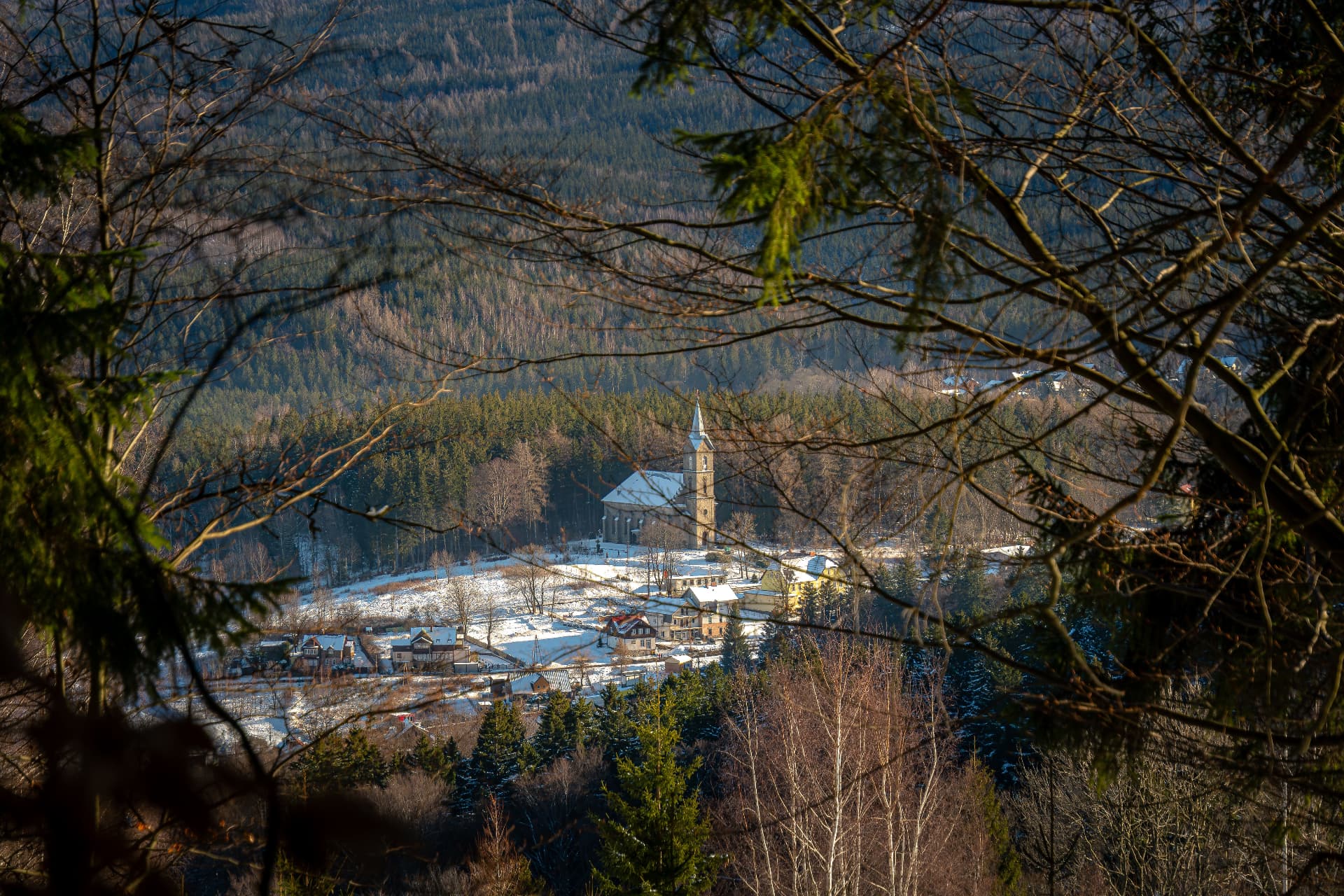
I've shot here in deep winter and in high summer. The photo above is the view that made me keep coming back — a hillside church in the valley, snow on the fields, everything framed by pine. This guide covers why Szklarska Poręba is worth the detour, how to get there, when to go, what to actually do once you're in town, and the practical stuff nobody tells you before your first Karkonosze hike.
Why visit Szklarska Poręba?
A few reasons it earns a spot on a Poland itinerary:
- Karkonosze National Park starts at the edge of town. You can walk from your guesthouse to a trailhead. No shuttle buses, no 5 a.m. drive to a car park that fills by six.
- A ridge you can stand on without technical climbing. The main Karkonosze ridge runs at 1,300-1,500 m along the Polish-Czech border. Take the Szrenica chairlift up and most of the hard work is done for you.
- Waterfalls. Kamieńczyk and Szklarka are both short, signposted walks and both photograph well in any season.
- It works year-round. Skiing and cross-country in winter, hiking and long evenings in summer, gold and fog in October. Very few mountain towns are genuinely four-season.
- Price. Food, lifts, and accommodation are a fraction of what you'd pay in Austria or Italy for a comparable landscape.
- Czechia is a short walk away. You can cross the border on foot on the ridge, or drive fifteen minutes to Harrachov.
How to get to Szklarska Poręba
By plane
Wrocław (WRO) is the natural gateway — about 130 km, two hours by car. Prague (PRG) is a realistic alternative at roughly 200 km via Liberec and Harrachov, and often cheaper to fly into. Dresden and Berlin both work as a road trip start if you're coming from Germany.
By train
Trains run from Wrocław to Szklarska Poręba Górna, the upper station, in roughly three hours. There's also a cross-border line onward to Harrachov in Czechia — a genuinely lovely short ride through the forest, and one of the few passenger rail crossings in this stretch of mountains. Buy tickets on the Polish rail apps or at the station; regional trains are cheap.
By car
Driving is the easiest option, and the roads from Jelenia Góra or from the Czech side over the pass are good. Paid parking in town and at the Szrenica lift base is straightforward but fills up on winter weekends and in August — arrive before 9 a.m. or park lower and walk up.
Do you need a car?
Not if you're staying in town and hiking. The trailheads, the lift, the waterfalls and the restaurants are all walkable or a short bus ride. A car pays off if you want Karpacz, Chojnik Castle, Jakuszyce and the Czech side in the same trip.
Best time to visit Szklarska Poręba
Every month works here, but they're not the same trip:
- January-February — ski season on Szrenica, cross-country at Jakuszyce, frozen waterfalls, and the clean low light in the photo at the top of this post. Cold (often -5 to -12 °C on the ridge), busy at weekends, quiet midweek.
- March-April — snowmelt makes the waterfalls loud and full. Trails can be icy up high well into April; bring microspikes.
- May-June — my favourite. Long days, green forest, wildflowers on the ridge, and the crowds haven't arrived yet.
- July-August — warmest and busiest, especially the first three weeks of August when Polish holidays peak. Book accommodation weeks ahead. Afternoon thunderstorms are common on the ridge.
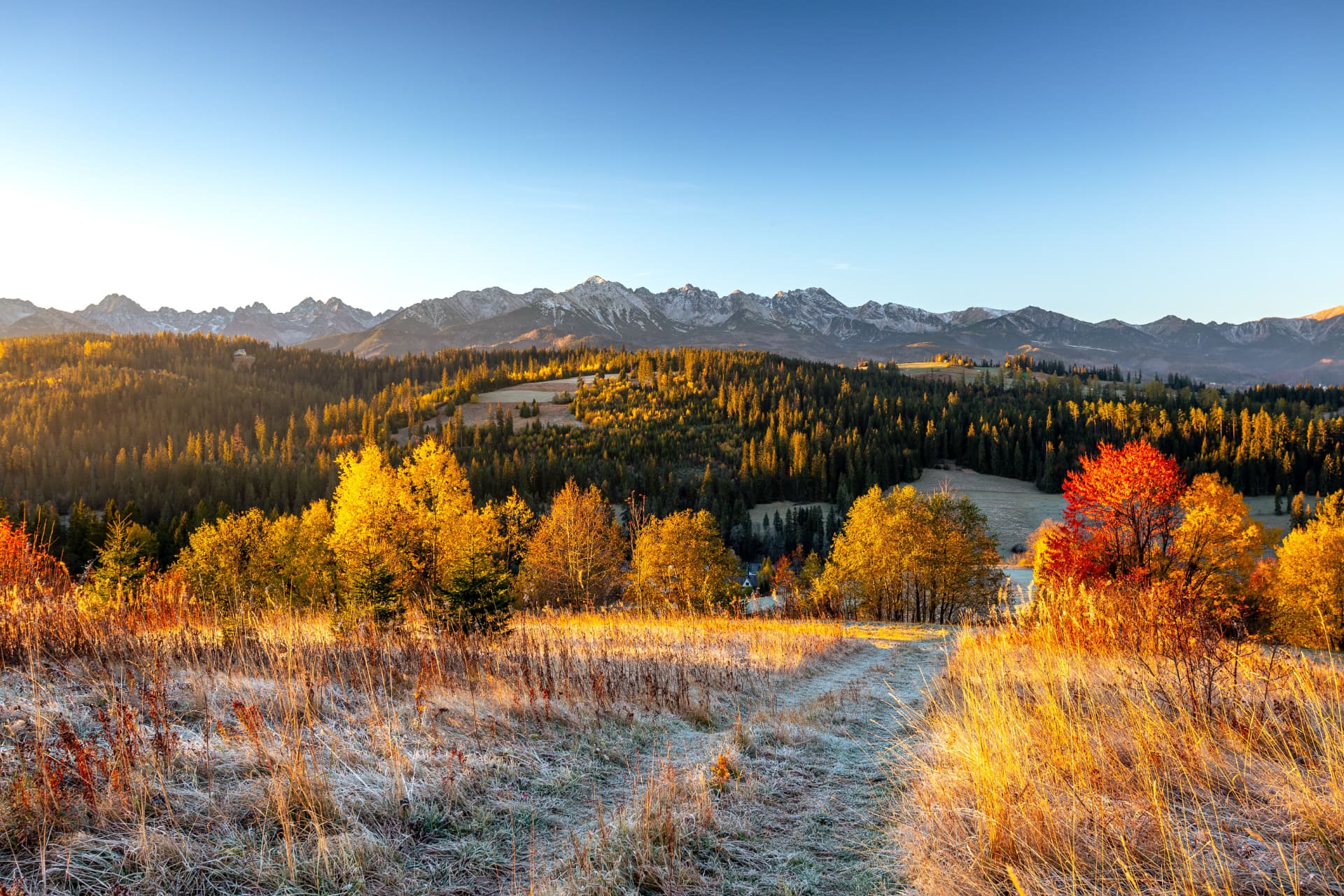
- September-October — the sweet spot for photography. Larch and beech turn gold, mornings bring temperature inversions with the valleys full of cloud, and prices drop.
- November — grey, wet, cheapest. Fine if you want empty trails and a spa afternoon.
- December — Christmas lights in town, early skiing if the snow cooperates, short days (dark by 16:00).
One planning note: the ridge has its own weather. It can be 18 °C and sunny in town and 4 °C with 60 km/h wind and no visibility at the top of the chairlift. Check a mountain forecast, not a town one.
What to see and do in Szklarska Poręba
Szrenica and the main ridge trail
The chairlift climbs to just under 1,360 m at Szrenica. From the top you can walk the red-marked ridge trail — the Polish-Czech Friendship Trail — with drops into Poland on one side and Czechia on the other. Walk east toward Śnieżne Kotły, two glacial cirques with near-vertical walls that are the most dramatic thing in the range, and descend back to town on a marked trail. Budget five to six hours for the full loop.
Kamieńczyk and Szklarka waterfalls
Wodospad Kamieńczyk is the tallest in the Polish Karkonosze at about 27 m, with a gorge below it you can walk into. Wodospad Szklarki is smaller but easier to reach, right beside the road to Jelenia Góra, with a mountain hut serving food next to it. Both have a small entry fee and both are best in spring melt or after rain.
Chojnik Castle
A ruined 14th-century castle on a rock spur above Sobieszów, about twenty minutes away by car. The final climb through the forest takes 30-40 minutes and the tower gives you the best panorama of the whole Karkonosze wall.
Glass, mining and rainy-day options
- Glassmaking — the town's name literally references glass. The Julia glassworks runs demonstrations where you watch pieces blown by hand, and there's a small museum shop attached.
- Kopalnia Św. Jan — a former uranium and fluorite mine you can walk through, plus a mineral museum. Cold inside; bring a layer.
- Dinopark — pure kitsch, but if you're travelling with kids it buys you a peaceful two hours.
- Ulica 1 Maja — the main street, with the market stalls selling sheepskin slippers, smoked cheese and honey. Worth a slow walk.
Day trips
- Karpacz and Śnieżka — 40 minutes by road. Śnieżka (1,603 m) is the highest peak in the range; the Wang wooden church in Karpacz is a 12th-century Norwegian stave church, moved here stick by stick in the 1840s.
- Jakuszyce — Poland's cross-country skiing capital in winter, mountain biking in summer.
- Harrachov, Czechia — fifteen minutes over the pass, with the huge ski jumps, a glassworks brewery, and cheap Czech beer.
Hiking in the Karkonosze: what to know first
- Trails are colour-coded, not numbered. Every route follows a colour (red, blue, green, yellow, black) painted on rocks and trees. Signposts give walking times in hours, not distances. Learn to read those and navigation is easy.
- The park charges a small entry fee at the main trailheads. Cash or card at the booth; keep the ticket.
- Stay on the path. The summit plateau is protected peat bog and tundra vegetation — fragile, and rangers do issue fines.
- Weather turns fast. Wind on the ridge is the real hazard, not altitude. Carry a shell, a warm layer, a hat and more water than you think.
- GOPR is the mountain rescue service — the emergency number is 601 100 300, or 112. Save both.
- Mountain huts (schroniska) sell hot food and drinks along the ridge. They take cards, mostly, but carry a little cash.
Photography notes
This is a landscape that rewards patience rather than a specific viewpoint:
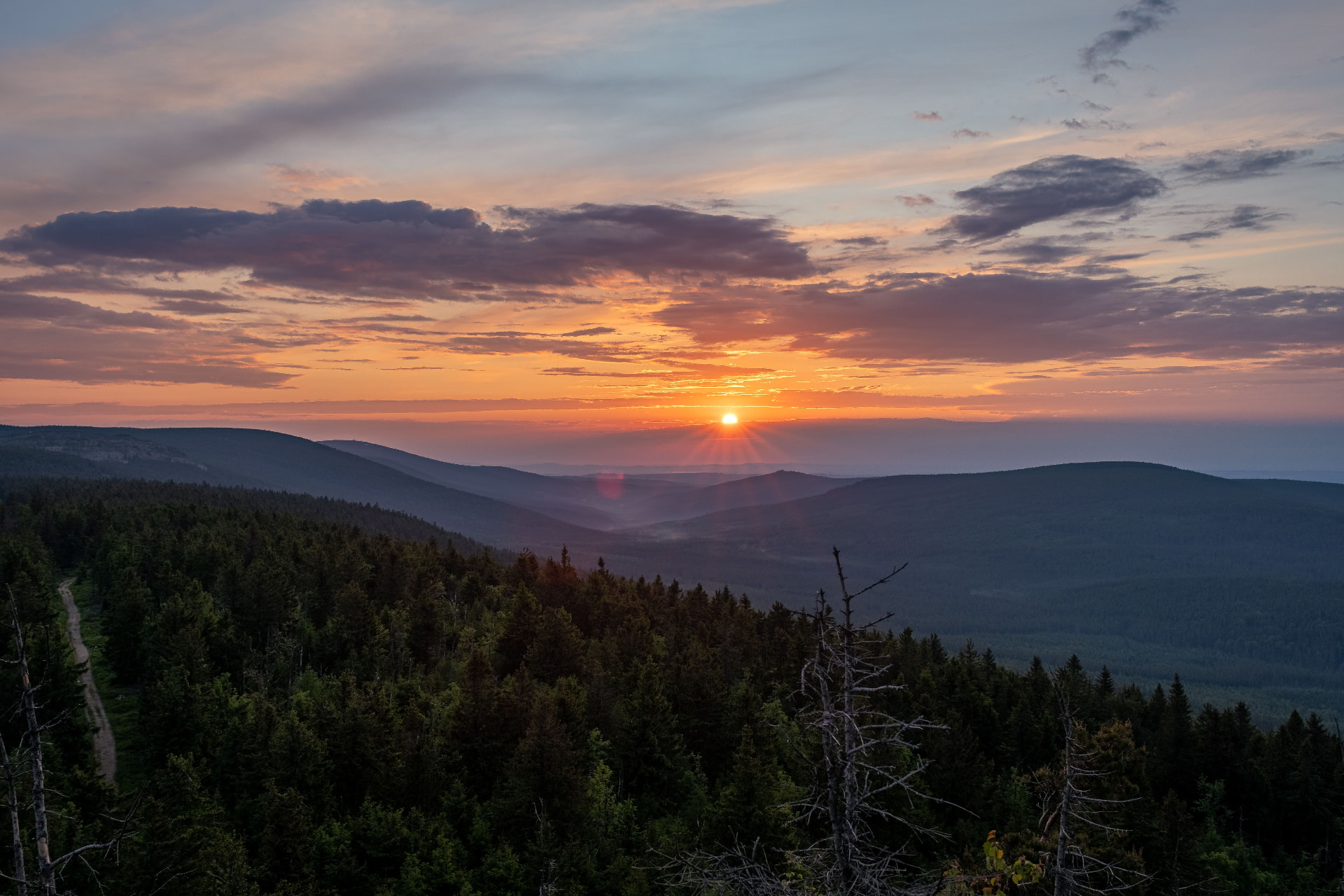
- Sunrise on the ridge is the shot. Get up with the lift closed — meaning you walk — or stay overnight in a schronisko and step outside at first light.
- October inversions fill the valleys with cloud while the ridge stays clear. Check for a cold, still, high-pressure morning after a wet day.
- Winter valley light stays low and warm all day in January, which is why the cover photo works. Long lenses compress the villages against the forest beautifully.
- Waterfalls want an overcast day, a polariser and a 1/4 to 1 second exposure. Bright sun blows out the white water.
- Drones: Karkonosze National Park is a no-fly zone for recreational flights without a park permit, and the Czech border adds a second layer of airspace rules. Fly outside the park boundary, check the Polish airspace app before takeoff, and read my EASA Open Category guide for how the EU framework actually works in practice.
Eating and drinking
Mountain Polish food, essentially, with a Silesian accent. Things to order:
- Placki ziemniaczane — potato pancakes, sometimes served drowned in goulash. The single best thing to eat after a cold hike.
- Pierogi ruskie — potato and curd cheese dumplings, fried or boiled.
- Żurek — sour rye soup, often served in a bread bowl.
- Oscypek-style smoked cheese from the market stalls, grilled with cranberry sauce.
- Nalewka — homemade fruit liqueur. One is hospitality, three is a decision.
- Beer — Polish craft brewing is excellent now, and the Czech taps fifteen minutes over the border are even cheaper.
Cards work almost everywhere, including most mountain huts, but keep 100-200 złoty in cash for trail fees, market stalls and parking machines.
A 2-day Szklarska Poręba plan
Day 1 — the ridge
Early breakfast, chairlift up to Szrenica, then the red ridge trail east toward Śnieżne Kotły. Lunch at a schronisko on the ridge. Descend on a marked trail back toward town in the afternoon, then a long dinner of placki and beer on 1 Maja.
Day 2 — waterfalls and town
Morning walk to Kamieńczyk waterfall and the gorge below it. Back to town for the glassworks demonstration, then Wodospad Szklarki in the late afternoon when the light gets into the trees. If it's raining, swap in the Św. Jan mine.
Day 3 (optional)
Either Karpacz — the Wang church and a push up Śnieżka — or Harrachov over the border for the ski jumps and a brewery lunch. Chojnik Castle fits either afternoon.
Practical tips
- Money: Poland uses the złoty (PLN), not the euro. Cards are near-universal; use bank ATMs, not the standalone tourist ones.
- Language: English is common with younger staff and in hotels, less so in mountain huts. Dzień dobry (hello), dziękuję(thank you) and proszę (please) go a long way.
- Sundays: most Polish shops close on non-trading Sundays. Restaurants and tourist attractions stay open; supermarkets often don't.
- Book ahead for winter weekends, the first half of August, and any long weekend on the Polish calendar. Midweek in June is wide open.
- Ski passes are sold per-day or by points at the lift base; rental shops sit right beside it.
- Spa afternoon: several hotels sell day access to pools and saunas — the correct move on a rainy day, or after a long descent.
- Footwear: the trails are rocky and often wet. Trainers are a mistake above the tree line.
FAQ
How many days do you need in Szklarska Poręba?
Two full days covers the ridge and the waterfalls. Three lets you add Karpacz, Śnieżka or the Czech side without rushing.
Is Szklarska Poręba worth visiting?
Yes — if you like mountains, walking and value for money. It is not a sightseeing city; the reason to come is the landscape on its doorstep.
Summer or winter?
Summer for hiking and long days; winter for skiing, frozen waterfalls and the best light. September and October split the difference and are the quietest good months.
Szklarska Poręba or Karpacz?
Karpacz is the better base for Śnieżka and feels slightly more resort-like. Szklarska Poręba has the waterfalls, the glass heritage, the Czech rail crossing and easier access to the western ridge. I prefer Szklarska Poręba; they're 40 minutes apart, so you can see both.
Do I need a car?
No, if you're hiking from town. Yes, if you want day trips to Chojnik, Karpacz and Harrachov in the same visit.
Can I climb Śnieżka from Szklarska Poręba?
You can walk the whole ridge from Szrenica to Śnieżka, but it's a long day — plan 7-9 hours and arrange transport back from Karpacz. Most people drive to Karpacz and go up from there.
Can I visit as a day trip from Wrocław or Prague?
From Wrocław, yes, with an early start — two hours each way leaves time for one waterfall and the lift. From Prague it's too much for a day; stay a night.
The bottom line
Szklarska Poręba is the kind of place that ruins your assumptions about Poland. Real mountains, a border ridge you can walk in an afternoon, waterfalls, glassblowers, and dinner for the price of a coffee in the Alps. If you're already planning a Poland trip, it slots neatly alongside the Samsara off-grid stay in Międzygórze an hour and a half east, or a coastal week around Gdańsk and Sopot at the other end of the country.
If you need mountain photography, aerial work or destination content from this part of Europe, get in touch — I shoot here regularly and know the light.