Wrocław Dwarfs (Krasnale): History, Meaning & Map Tips
Why Wrocław has hundreds of bronze dwarfs — the Orange Alternative protest history, what the krasnale mean, the notable ones, the September festival and how to find them.
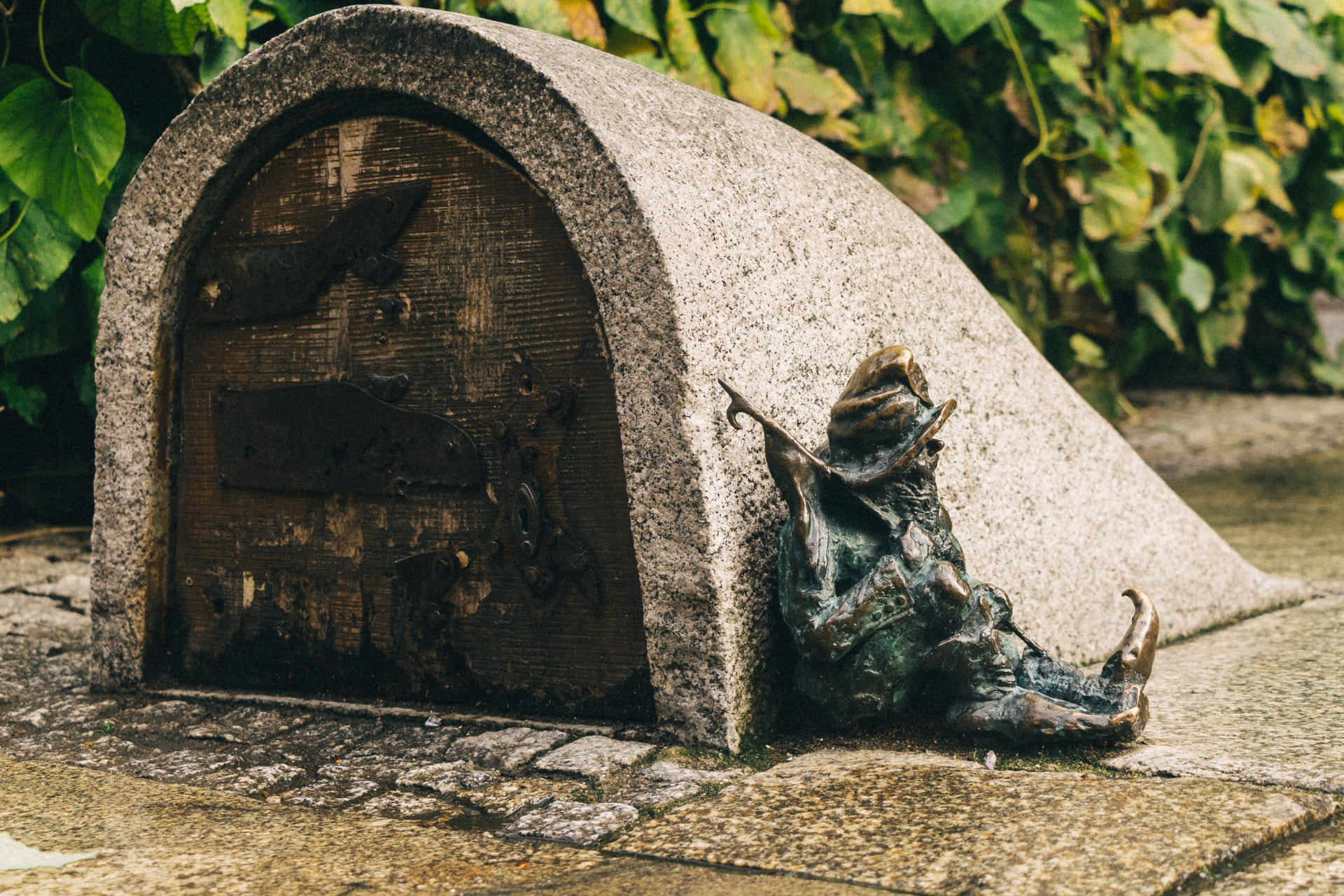
The first Wrocław dwarf you meet will probably be an accident. You're looking up at the gabled houses on the Rynek, you step back to frame a shot, and there — at ankle height, against a doorstep — is a bronze figure the size of a shoe, doing something faintly absurd. Then you see another. And then you realise there are hundreds of them, and that half the people around you are walking with their heads down, hunting.
The krasnale (Polish for dwarfs or gnomes) are the closest thing Wrocław has to a mascot, and by far its most photographed export. They are also, unlike most city mascots, a genuine political memorial. This is the full story: where they came from, what they mean, which ones are worth walking for, the events built around them, and how to photograph them properly instead of taking the same waist-height snapshot as everyone else.
Why does Wrocław have dwarfs?
Because in the 1980s, mocking the government with chalk gnomes was safer than mocking it with words.
Under martial law and the years that followed, Wrocław was home to the Orange Alternative (Pomarańczowa Alternatywa), a movement founded by Waldemar Fydrych — known as Major — that fought communism with absurdity rather than confrontation. Instead of clashing with the militia, they staged happenings: handing out toilet paper as a "gift" during shortages, marching in pointed hats, distributing sanitary pads, holding a parade for the anniversary of the October Revolution so enthusiastic it became a parody.
The dwarfs came out of the same logic. When the authorities painted grey rectangles over anti-government graffiti, activists painted small gnomes on the fresh patches. The grey squares were meant to erase dissent; the gnomes turned every one of them into a punchline. And the state was trapped: arresting a student for a cartoon gnome makes the police look ridiculous, and ridicule was exactly the point. Hundreds of dwarfs appeared on walls across Wrocław and other Polish cities.
That is the layer most visitors miss. The bronzes are cute. The thing they commemorate is non-violent resistance that worked.
From protest graffiti to bronze statues
The transition happened slowly. In 2001, a figure called Papa Krasnal was placed on ul. Świdnicka — the street where many of the Orange Alternative happenings took place — as a direct memorial to the movement.
In 2005 the city commissioned a small set of sculptures from artist Tomasz Moczek, and those became the template everyone copies: the Syzyfki (two Sisyphus dwarfs straining to push a stone ball), a butcher, a swordsman, a washerwoman. They were small, waist-high to a toddler, cast in bronze, and set directly into the pavement rather than on plinths. Nothing about them says "monument", which is why they worked.
After that it snowballed. Businesses, institutions, universities, charities, embassies, hospitals and residents' associations started commissioning their own, usually placed outside whatever they represent and approved by the city so the placement makes sense. The commonly quoted count is 600 or more, and it keeps rising — nobody who visits twice sees the same city inventory.
What the krasnale actually mean
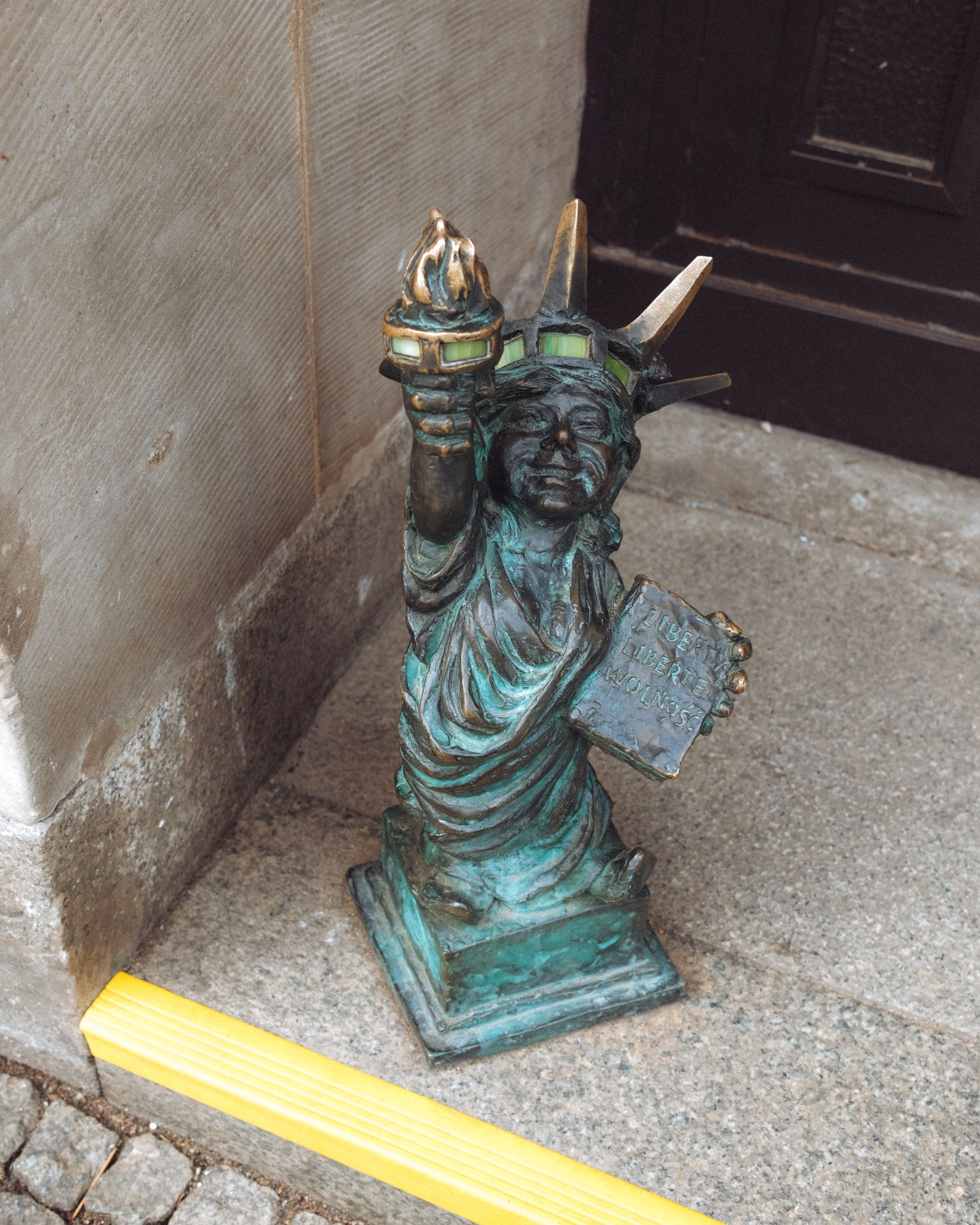
Four things run through the collection once you start reading them rather than just counting them:
- Freedom and civic memory. The oldest and most deliberate dwarfs point back at the Orange Alternative and at the idea that humour is a legitimate political tool. The Liberty dwarf above spells it out in three languages.
- Accessibility made visible. A group near ul. Świdnicka represents disabled residents — a dwarf in a wheelchair, a blind dwarf with a cane, a deaf dwarf signing, one with a hearing aid. They were installed as part of an awareness campaign, and they do the job better than a poster ever did: you have to crouch to see them properly.
- Local trades and institutions. A bank dwarf at an ATM, a baker outside a bakery, a prisoner behind bars, a firefighter at a station, a postal dwarf by a post office, a musician outside a concert hall. The statues quietly map what the street actually does for a living.
- City marketing, honestly. Plenty of the newer ones are sponsored advertising in bronze, and locals will say so. It doesn't cancel the earlier layer — but if a dwarf looks like a logo with legs, that's usually because it is.
Where to find the Wrocław dwarfs
- The Rynek. Densest concentration in the city. One slow lap of the market square and the Old Town Hall will get you six to ten, including the Sisyphus pair and the lamp-post climbers.
- ul. Świdnicka. Papa Krasnal and the accessibility group. This is the historically meaningful stretch, not just the photogenic one.
- Ostrów Tumski and Sand Island. Fewer dwarfs, better light, and you get the cathedral and the gas lamps in the same walk.
- Nadodrze. Post-industrial, half-gentrified, full of small workshop dwarfs. The best neighbourhood-discovery half of the hunt.
- Wrocław Główny station and the airport. There are dwarfs at both, so your first and last five minutes in the city can each include one.
- Maps and apps. Paper maps sell for a couple of złoty in kiosks and souvenir shops, there are official city listings online, and phone apps let you tick off the ones you've found. With kids, the app plus a target number is the whole game.
Realistic expectations: two to three hours of relaxed walking in the centre gets you 25-40 dwarfs. Finding all 600 is a project, not a morning, and a fair number sit in outer districts you'd never otherwise visit — which is precisely why some residents do it as a hobby.
A 2-3 hour dwarf-hunting walking route
This loop starts and ends on the Rynek, covers roughly 5 km on flat ground, and passes the historically important dwarfs first — so if you run out of time or energy, you've still seen the ones that matter. Allow 2 hours at a brisk pace, 3 if you're stopping for photos and coffee, which you should.
- Start: Old Town Hall, Rynek (0:00-0:20). Do one slow lap of the market square before the crowds arrive. The Syzyfki pair pushing their stone ball sit on the square's south-west side, and the Old Town Hall façade hides several more at its base and on the lamp posts. Early morning light hits the gabled houses from the east — the best shooting window of the day.
- ul. Świdnicka (0:20-0:50). Leave the square's south-west corner and walk the length of Świdnicka. This is the historic stretch: Papa Krasnal — the 2001 original and the memorial to the Orange Alternative — stands near the start of the street, and the accessibility group (wheelchair, blind, deaf, hearing-aid dwarfs) is further along. Crouch down for these; they're designed to be read at their level, not yours.
- Back to the Rynek via the side streets (0:50-1:20). Cut back north-east through the lanes between Świdnicka and the square. This is where the trade dwarfs cluster: the bank dwarf at his ATM, the prisoner behind his bars, and a rotating cast of bakers, butchers and musicians outside their real-world counterparts. Every doorway is a candidate — walk slowly.
- Coffee stop on the Rynek (1:20-1:40). You're a third of the way in and back at the square. Take twenty minutes — the terraces on the square's east side get the midday sun, and you'll spot three or four more dwarfs from your chair.
- Across to Sand Island and Ostrów Tumski (1:40-2:30). Head north-east out of the square, cross Most Piaskowy (the bridge with the padlocks), and loop through Sand Island and Cathedral Island. The dwarfs are sparser here, but you're trading quantity for the cathedral, the gas lamps and the best river views in the city. If the lamplighter is out at dusk, the walk back over Tumski Bridge is the single most photogenic ten minutes in Wrocław.
- Return along the Odra (2:30-3:00). Walk back west along the boulevards to the Rynek. Count your haul: 25-40 is normal, 50 is a good day. Anything above that and you've stopped being a tourist and become a krasnal hunter.
Short on time? The 90-minute version is stops 1-4 only: the Rynek, Świdnicka and the side streets contain the densest and most meaningful cluster, and you skip the island leg entirely.
Notable dwarfs worth a detour
- Papa Krasnal (ul. Świdnicka) — the original, 2001, the memorial to the Orange Alternative.
- Syzyfki (Rynek / Świdnicka area) — two dwarfs pushing a stone ball, the most photographed pair in the city.
- Krasnal Więzień — the prisoner, gripping the bars of his cell.
- The bank dwarf — withdrawing cash from an ATM, the cleanest joke in the collection.
- The Liberty dwarf — torch up, tablet reading Wolność.
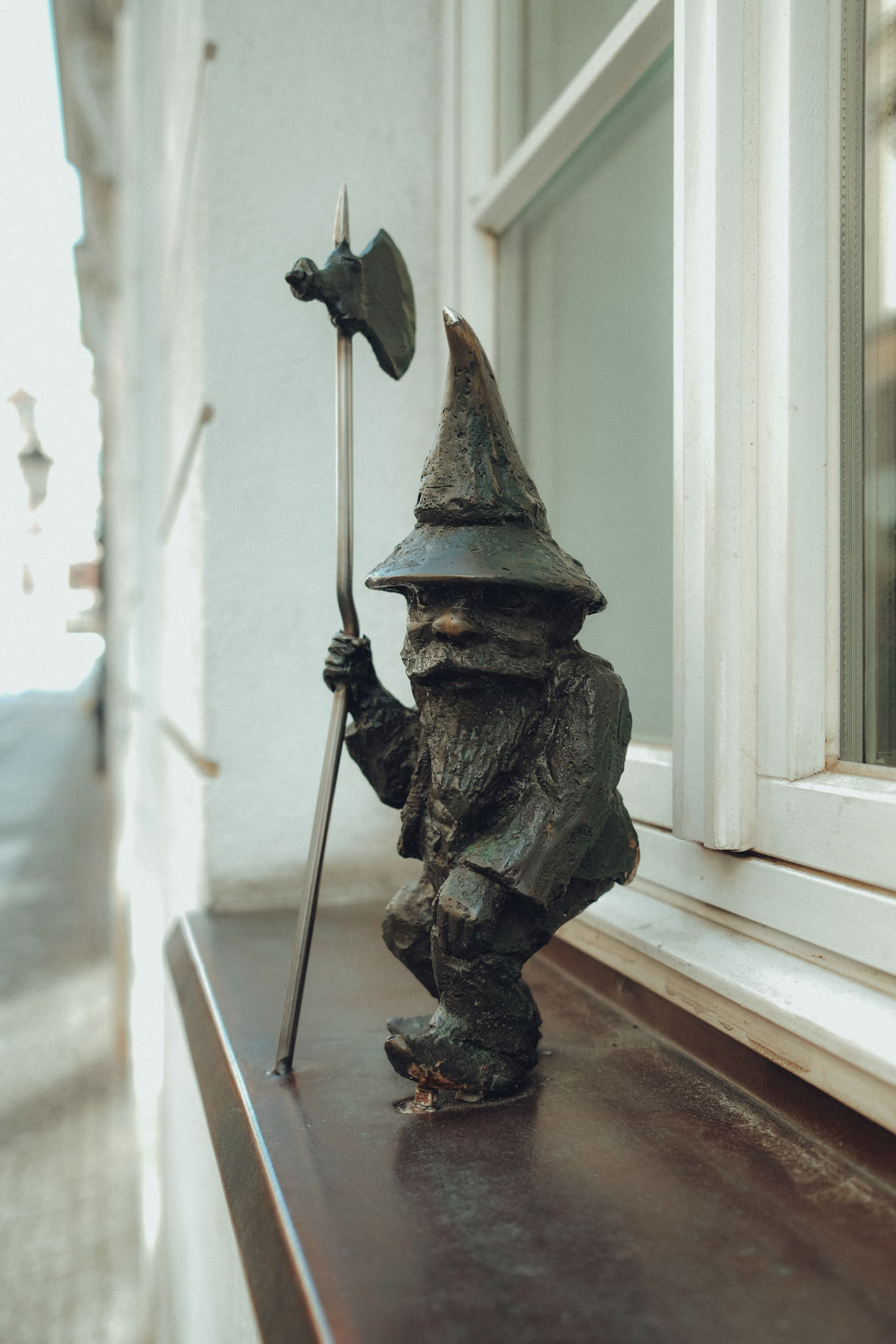
- The guard / halberdier — armoured and armed, keeping watch on a ledge.
- The accessibility group — wheelchair, blind, deaf, hearing aid. The most important five minutes of the hunt.
- Trade and service dwarfs — firefighter, postman, baker, butcher, washerwoman, musician, each parked outside its real-world counterpart.
Events: the Wrocław Dwarf Festival and other traditions
- Święto Krasnoluchów (the Dwarf Festival). Usually in September, spread across the Old Town and the islands: parades of children in pointed hats, street theatre, workshops, treasure hunts and new dwarf unveilings. If you can time a trip to it, do — it's the one weekend a year when the whole city plays along.
- Orange Alternative anniversaries. Commemorations and happenings around the movement's key dates keep the political thread alive, often on Świdnicka and often deliberately silly.
- Christmas market trails. During the Rynek market some dwarfs get seasonal decoration and the sellers hand out trail maps — dwarf hunting in the dark with mulled wine is better than it sounds.
- School and charity dwarfs. A steady stream of new statues comes from fundraisers, hospitals and NGOs, each with an unveiling and a story.
- Thefts and rescues. Dwarfs occasionally get stolen or damaged, which reliably makes the local news and reliably produces a public campaign to recast them. The city takes them seriously precisely because they're not serious.
Photography notes
- Get down to their level. Camera on the pavement, screen flipped up if you have one. Waist-height snapshots all look identical; eye-level shots look like portraits.
- Include the street. A wide-ish lens at a low angle puts the dwarf in the foreground and the Rynek façades or a doorway behind it. Context is what makes the frame legible.
- Overcast is your friend. Bronze in hard midday sun goes blotchy and contrasty. Grey Wrocław light — which is most of the year — renders the patina beautifully.
- Watch your own shadow. Crouched over a small subject you will shade it. Move around so the light comes past you, not through you.
- Shallow depth of field, but not too shallow. f/2.8-f/4 separates the figure without dissolving the detail on the face and hands.
- Early morning on the Rynek. Before about 9am you get the square almost to yourself; after midday you'll be waiting behind tour groups at every popular dwarf.
- Don't touch, climb on, or repaint them. They're public art and some are decades old. Rubbing them "for luck" is how the patina goes.
Practical tips
- Best time: April to October for comfortable walking, September if you want the festival, December for the market trail. Winter mornings are cold but empty.
- Wear real shoes. This is a cobblestone activity, and you'll cover 6-10 km without noticing.
- With kids: give them the map and a target ("find twenty"). It converts a sightseeing day, which children hate, into a scavenger hunt, which they don't.
- Accessibility: the Old Town core is flat, but cobbles are rough and many dwarfs sit against steps and thresholds. The Świdnicka accessibility group and the Rynek cluster are the easiest to reach.
- Money: cards work nearly everywhere, but keep a few coins for a paper dwarf map or a church tower.
- Souvenirs: replica dwarfs are everywhere and mostly identical. The good version of the souvenir is your own photo set.
FAQ
How many dwarfs are in Wrocław?
More than 600, and the number grows every year as businesses, charities and institutions commission new ones. No single list stays current for long.
Why does Wrocław have dwarfs?
They commemorate the Orange Alternative, an anti-communist protest movement that painted gnomes over the grey patches censors used to cover anti-government graffiti in 1980s Wrocław. The bronzes came later, starting in 2001.
Who made the Wrocław dwarfs?
Papa Krasnal (2001) was the first bronze. The 2005 set that defined the style — the Sisyphus dwarfs, butcher, swordsman, washerwoman — was sculpted by Tomasz Moczek. Many artists have contributed since.
Where should I start dwarf hunting?
The Rynek, then ul. Świdnicka for Papa Krasnal and the accessibility group, then outwards to Nadodrze or Ostrów Tumski depending on your appetite.
Is there an official dwarf map?
Yes — paper maps are sold cheaply in kiosks and souvenir shops, the city publishes listings online, and several phone apps let you log the ones you've found.
How long does the dwarf hunt take?
Budget two to three hours for 25-40 dwarfs in the centre. Completists spend repeated trips on it.
Can I sponsor or commission a dwarf?
In practice yes — most new statues are privately funded by businesses, institutions or fundraising campaigns, with the location agreed with the city. It needs an artist, a permit and a reason for the placement, not just money.
The bottom line
Spend one morning on the krasnale and Wrocław stops being a pretty market square and becomes a city with a sense of humour about its own history. That's a rare thing, and it's free.
If you're planning the wider trip, my Wrocław travel guide covers the history, the Rynek, Ostrów Tumski, the best months and a 2-day plan. Pair it with Kraków, Poznań and Gdańsk and Sopot for a full Poland route. Need photography or drone coverage of a Polish city? Get in touch.